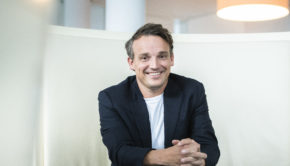

Arthur Mensch co-founded Mistral AI in 2023 after leaving Google DeepMind. The decision to launch a new laboratory in Paris, rather than join an existing American AI giant, carried an implicit argument: that Europe could build foundation models capable of competing globally. Within two years, Mistral had completed multiple funding rounds and established a commercial offering built around its Mistral Large language model.
The September 2026 Series D confirmed the company’s trajectory. Samsung Electronics led the €3 billion raise, with EQT’s Scaleup Europe Fund and PSG Equity as co-leads, and previous investors also participating. The round placed Mistral’s valuation above €21 billion. TechCrunch described it as “the largest equity fundraising round ever completed by a European technology company,” a designation that puts the Paris lab in the company of the continent’s most established software and industrial groups.
Open-Source as Economic Logic
What sets Mensch apart from many peers in the AI sector is a consistent, publicly argued commitment to open-source model releases. Where most large-scale AI systems have been built behind proprietary walls, Mistral has published its models openly, enabling developers and organisations to adapt and build on them without restriction.
Mensch has framed this not as altruism but as economic reasoning. In a Bloomberg video interview tied to the Series D announcement, he argued that macroeconomic forces are beginning to confirm Mistral’s early bet: that open-source models will prove more durable because they drive wider adoption and reduce the structural costs of AI integration across sectors. His case rests on cost curves and developer dynamics, and the scale of Mistral’s recent fundraising suggests investors have found it credible.
A Partnership Reaching into Semiconductor Manufacturing
The Samsung investment did not stop at capital. A joint press release published on BusinessWire in September 2026 outlined a formal strategic partnership under which Samsung will integrate Mistral’s AI services across its semiconductor operations, applying large language models to chip design and manufacturing.
Mensch’s framing of the collaboration is worth quoting directly. “AI is reshaping how we build complex technologies, from silicon to software,” he stated in the release, adding that Mistral is “proud to support Samsung Electronics with our expertise in electronics and semiconductors, helping to improve how chips are designed and manufactured.” These words signal a deliberate repositioning: Mistral is not a productivity tool supplier but a partner embedded in one of the world’s most capital-intensive industrial processes. The shift in register from consumer AI to semiconductor infrastructure reflects an ambition that extends well beyond chatbot applications.
The Case for European Sovereignty
Alongside open-source, the concept of “sovereign AI” has been central to Mistral since its founding. The idea is that Europe needs AI capabilities that do not run entirely on American cloud infrastructure. Bloomberg’s European business coverage cited Mistral as evidence that the continent’s technology firms are “down but not out” in the global AI race, and Mensch has emerged as one of the more coherent voices making that argument in public forums.
The composition of the Series D round is itself a data point for his thesis. Samsung’s decision to lead the investment, rather than any of the dominant American technology platforms, gives Mistral a major hardware partner outside Silicon Valley’s orbit. EQT’s Scaleup Europe Fund adds a European institutional anchor. The result is a capital structure that mirrors Mistral’s positioning: global in reach, and not dependent on any single geographic or platform power.
The Remark That Reveals the Man
In the Bloomberg interview accompanying the funding announcement, Mensch made an observation that stood out given the context. Having just closed a €3 billion round at a €21 billion valuation, a milestone that most founders would present as a ceiling reached, he told the interviewer that Mistral was “probably still undervalued.” The remark was not theatrics. It followed a structured argument about open-source economics and the scale of the AI opportunity. Whether or not his arithmetic eventually proves correct, the willingness to say it publicly, at that precise moment, reveals a founder who has bound his personal credibility to a long-term thesis, and who has decided that confidence, stated plainly, is itself part of the strategy.