
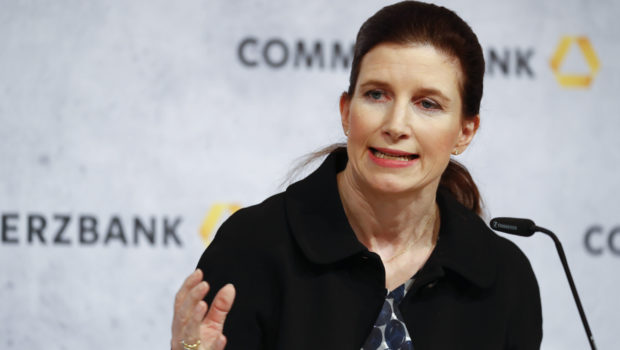
Bettina Orlopp’s path to the chief executive role was built on financial expertise and institutional familiarity. She previously served as Commerzbank’s Chief Financial Officer, overseeing the bank’s balance sheet and capital position through a prolonged period of restructuring. Commerzbank had spent much of the previous decade reducing headcount and shedding non-core assets, while strengthening regulatory ratios after the strains of the global financial crisis required a government rescue. The German federal government remains a significant shareholder today, which gives any change in corporate control a political dimension absent from most private-sector takeovers.
Her promotion to CEO placed her in a select cohort: women holding the top executive role at a major European bank remain rare. The appointment reflected both her standing within the institution and the board’s judgment that her mastery of the bank’s financial architecture made her the right leader for a period of continued stabilization.
The UniCredit Question
When UniCredit SpA began acquiring Commerzbank shares and signaling a desire for a controlling position, the situation created an unusual governance dynamic. UniCredit CEO Andrea Orcel’s stated ambition was to install a new supervisory board at Commerzbank that would reflect his group’s interests. For Orlopp, this was not primarily a question of national ownership or shareholder returns. It was a question about the relationship between those who run a bank and those charged with overseeing them.
Her response, delivered in September 2026 and reported in detail by Bloomberg, was measured and precise. She stated that being a management board member “only makes sense if, first, there is a relationship of trust between the supervisory board and the management board and, second, there is agreement on the strategy.” She followed this with a sentence that left little room for ambiguity: if those conditions are not present, “you have to draw the consequences.”
A Clear Statement Under Takeover Pressure
What gave Orlopp’s remarks their particular weight was not defiance but clarity. Most executives under takeover pressure default to reassurances about shareholder value or process. She chose instead to explain, in public, what she considers the minimum requirements for a functioning leadership structure. A Bloomberg newsletter covering European banking consolidation framed the broader implication: “being big in banking doesn’t guarantee you’ll control your own fate.”
Her willingness to articulate personal terms, and to imply she would leave if they went unmet, was unusual in an environment where CEOs typically soften such positions behind layers of legal and communications advisers. The statement revealed a conception of the CEO role as inherently relational: authority, in her framing, is not merely conferred by appointment but sustained by genuine alignment between the boardroom and the executive floor.
It is, in a way, the kind of remark that takes years to be in a position to make. By the time a CFO becomes CEO and then finds herself at the center of a continental banking standoff, the calculation of what is worth defending becomes deeply personal. For Orlopp, the answer appears to lie less in the title itself than in the conditions that make the title worth holding.