
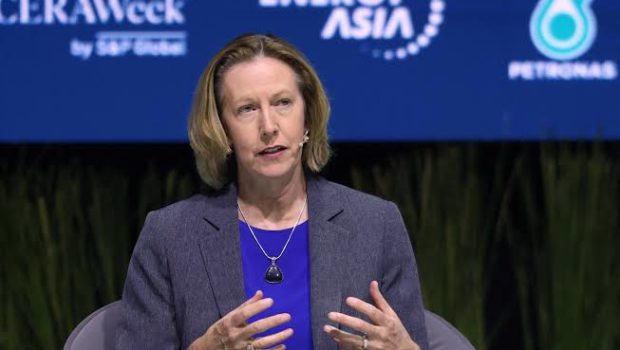
From Woodside to BP
Meg O’Neill‘s path to the CEO role at BP is rooted in operational energy leadership across two continents. Before joining BP, she served as chief executive of Woodside Energy, an Australian group. During her tenure, she orchestrated the acquisition of BHP Petroleum International, a deal that transformed Woodside into the largest energy company listed on the Australian Securities Exchange and built a geographically diverse portfolio of oil and gas resources spanning the Pacific, the Americas and Africa. That transaction established her reputation as an executive capable of reshaping a major energy company through a structurally significant acquisition.
Her appointment in April 2026 made her the fourth person to hold the CEO role at BP in five years, a frequency that reflects the turbulence at the company’s senior levels in recent years. Former CEO Murray Auchincloss and chairman Albert Manifold had both departed before her arrival. Forbes noted that O’Neill brought “a refreshing change in tone, instilling confidence and visibly accelerating the reset process,” a marked contrast with the strategic ambiguity that had weighed on BP’s market position.
The Hard Reset
The most consequential early decision of O’Neill’s tenure at BP has been what Fortune describes as her willingness to “rip up the energy giant’s playbook, and the ‘green’ era with it.” Under her predecessor Bernard Looney, BP had committed to ambitious renewable energy targets and invested substantially in wind power. O’Neill has pulled back from capital-intensive projects that did not meet BP’s risk-adjusted return thresholds, refocusing the group on cost efficiency and disciplined capital allocation in its core oil and gas operations. Forbes characterises this as a “back-to-basics” strategy, reinforcing BP’s competencies in traditional hydrocarbon production.
The shift carries concrete financial implications. BP faces pressure to reduce leverage and generate consistent returns for shareholders at a time when several major oil companies, including Shell, have also recalibrated their renewable commitments. O’Neill’s approach is framed publicly not as an abandonment of environmental goals but as a recalibration of pace and investment priorities, anchored in what BP can deliver reliably under current market conditions.
Portfolio Logic at the Largest Scale
One of the clearest signals of her pragmatic approach involves BP’s largest oil discovery in 25 years. Bloomberg reported in November 2026 that BP is in negotiations with Petrobras to sell a stake in the Bumerangue block, an offshore find off Brazil’s coast of exceptional scale. For a new CEO to countenance divesting from such a discovery, rather than developing it entirely within BP’s portfolio, underlines the return-driven logic she is applying across the company’s global assets. Her trajectory from Woodside to BP also illustrates the increasingly globalised nature of energy leadership: her experience managing stakeholders across the Asia-Pacific region has translated into a remit that now spans the North Sea, the Gulf of Mexico and deepwater Latin America.
Her appointment carries significance beyond any single portfolio decision. Fortune described her arrival as marking the first time a woman has led a Big Oil giant of BP’s scale. BP, with operations spanning upstream exploration and production alongside downstream refining and energy trading, has historically been led by a succession of male executives. This context does not alter the structural pressures facing the company, but it marks a visible shift in the demographic profile at its most senior level.
A Willingness to Let Go
The sharpest human detail in O’Neill’s early tenure may be this readiness to sell a once-in-a-generation asset. Executives at oil majors typically hold onto significant discoveries as symbols of their company’s exploration capability. That O’Neill appears prepared to bring in a partner or reduce BP’s stake in the Bumerangue block, according to Bloomberg’s November 2026 reporting, says something specific about her priorities: she appears to view balance-sheet discipline and investor confidence as constraints that outweigh the prestige of a landmark geological find. For a company whose recent history has included repeated strategic pivots and leadership changes, this posture represents something more consistent, a CEO who does not romanticise her assets.