From Taipei to Silicon Valley
Jensen Huang was born in Taiwan in 1963 and spent part of his childhood in Thailand before his family emigrated to the United States. He arrived as a teenager with limited English and has described this period of economic insecurity as foundational to his outlook on both risk and public institutions. He studied electrical engineering at Oregon State University and later earned a master’s degree from Stanford University. Early in his career, he held roles at LSI Logic, where he gained grounding in microprocessor design and semiconductor economics.
Co-Founding Nvidia and Betting on the GPU
In 1993, Huang co-founded Nvidia alongside Chris Malachowsky and Curtis Priem, targeting the early market for PC graphics. The company’s trajectory involved a series of strategic pivots: from programmable gaming chips to parallel computing platforms used in scientific research, and from there to the hardware and software stacks that now underpin AI workloads globally. By 2024, Nvidia’s H100 GPU families had become the standard for training large language models, and the company had emerged as one of the most valuable firms in the world by market capitalisation. Bloomberg has described Nvidia as functioning like “AI’s central bank,” a reference to Huang’s role in allocating the scarce compute capacity that shapes which AI projects can run, at what scale, and when.
Europe and the AI Imperative
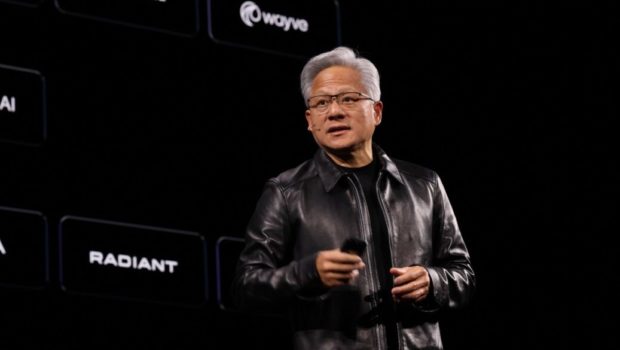
In October 2026, Huang delivered the keynote at Nvidia‘s GPU Technology Conference in Berlin, where he urged European industries and policymakers to accelerate AI adoption across every sector. He argued that Europe would only capture the technology’s benefits if “all of the end markets, the end industries” integrated AI into their operations, and he unveiled new data-centre equipment, software partnerships, and integrations with leading European companies.
A separate engagement in London offered a sharper edge. Speaking in a converted church to an audience of politicians and investors, Huang said the United Kingdom had “enough intellect but not enough entrepreneurial spirit,” describing a tendency to find “the one reason not to do it” when confronted with opportunity. The remarks drew a public response from the UK Chancellor of the Exchequer, who posed with a bottle of HP Sauce and declared the upcoming budget dedicated to “bloody minded entrepreneurs.” Huang had already backed his diagnosis with capital, committing investments in five British start-ups.
Around the same time, he addressed scrutiny of Nvidia’s stake in neocloud provider CoreWeave, describing such investments as “good investments” with “incredible” demand for compute. His defence was direct and public.
The Billionaire Who Fears Poverty
The most revealing detail about Huang may not concern artificial intelligence at all. When California legislators debated Proposition 40, a proposed one-time 5% levy on residents with assets above one billion dollars, several of the state’s wealthiest individuals campaigned against the measure or relocated to lower-tax states. Huang, whose net worth Fortune reported at approximately 180 billion dollars in October 2026, making him the world’s ninth-richest person, took a different position.
In an interview with CBS Sunday Morning, covered by Fortune in October 2026, he described himself as “the ultimate American Dream” and called the prospect of paying an estimated eight billion dollars in taxes over five years “a privilege.” He added, with characteristic bluntness, that he was “not afraid of paying taxes” but remained “just afraid of being poor.” His argument extended beyond personal philosophy. He pointed to California’s public universities and infrastructure as the foundations that made his education and the early Nvidia relationships possible, urging wealthy peers to “move to California, don’t leave” despite acknowledging the state’s position as having “the highest taxes in the world.”
The statement offers something rare from a founder-CEO of his stature: an unguarded account of a formative fear that outlasted the poverty that caused it. Thirty years after co-founding a chip company, Huang speaks less like a man who has conquered insecurity than like one still running, purposefully, from its memory.