From Physics Lab to Maranello
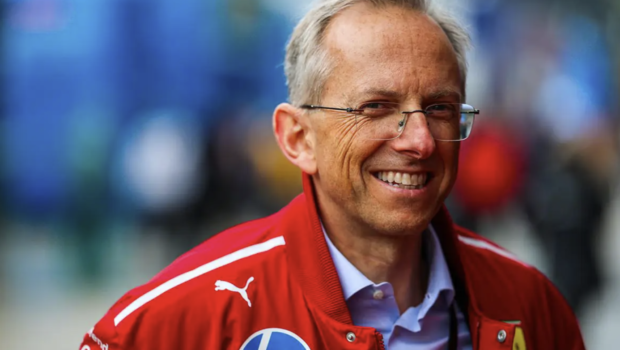
Vigna studied physics at the University of Pisa, one of Italy’s most respected scientific institutions. He did not enter the automotive industry. Instead, he joined STMicroelectronics in the 1990s, building a career in microelectromechanical systems, known as MEMS, and sensors. Over nearly three decades, he advanced to lead the company’s Analog, MEMS and Sensors Group, a division whose components ended up inside hundreds of millions of smartphones, fitness trackers and automotive navigation systems worldwide. It was a technical career conducted largely out of public view, in a B2B environment where success was measured by component reliability and design-win rates rather than brand recognition or consumer excitement.
An Appointment With Clear Strategic Logic
Ferrari’s board appointed Vigna as Chief Executive Officer in September 2021, succeeding Louis Camilleri. The choice generated commentary. Vigna had no prior experience running an automotive company, and Ferrari is among the most emotionally loaded brands in global consumer culture. The rationale, however, was coherent. Ferrari’s transition toward electrification, its growing reliance on software for performance management, and its dependence on advanced sensor architectures for driver-assistance systems all pointed toward a leader who could grasp the engineering foundations of the next generation of its products. A physicist who had spent decades at the frontier of semiconductor technology was, in that light, a purposeful selection.
Volume Discipline and a Full Order Book
Since taking over, Vigna has maintained Ferrari’s foundational commercial strategy: strict production limits that keep demand structurally above supply. He has consistently framed this discipline as central to brand preservation, not as a constraint but as a competitive lever. Speaking to Fortune, Vigna stated that he was “very pleased with how orders are proceeding,” with the company’s order book filled through 2027. That figure, reported in July 2026, reflects how Ferrari has continued to convert scarcity into pricing power and long-term customer commitment under his leadership, even as rivals race to expand volume.
When the Internet Mocks and the Market Buys
One episode from Vigna’s tenure captures the balancing act he performs each time Ferrari releases a new model. A Ferrari design co-created with Jony Ive, the British designer who shaped Apple’s product aesthetic over two decades, attracted pointed criticism when images circulated online. Observers argued the car departed too sharply from Ferrari’s established visual language. The commentary was rapid and blunt.
The commercial outcome told a different story. Fortune reported in July 2026 that the model was “selling like hotcakes,” with demand absorbing supply regardless of the initial backlash. For Vigna, the episode illustrated a lesson that now runs through his public statements: the buyers who actually configure and purchase Ferrari vehicles operate on a different register from those who react to photographs on social media. Brand trust, accumulated over decades of racing history and engineering refinement, tends to outlast a news cycle.
The Scientist in the Spotlight
Vigna has spoken about the cultural adjustment involved in moving from STMicroelectronics to Ferrari. At the semiconductor company, a successful component is one that nobody notices: it disappears inside a device, performing its function without fanfare. At Ferrari, invisibility is simply not available. Every design choice, every public statement and every production number lands in a space of intense scrutiny. The contrast is not lost on him. His physics background may give him a particular tolerance for separating signal from noise, a disposition that proved useful in navigating social media storms over car design. Whether that temperament will serve him equally well as Ferrari manages the deeper uncertainties of full electrification remains the defining question of his tenure at Maranello.
Anecdotes
Benedetto Vigna reportedly drives a Ferrari to work every day, treating the car not just as a product but as part of his daily experience as CEO. For him, getting behind the wheel is a way to stay directly connected to what Ferrari customers feel.