
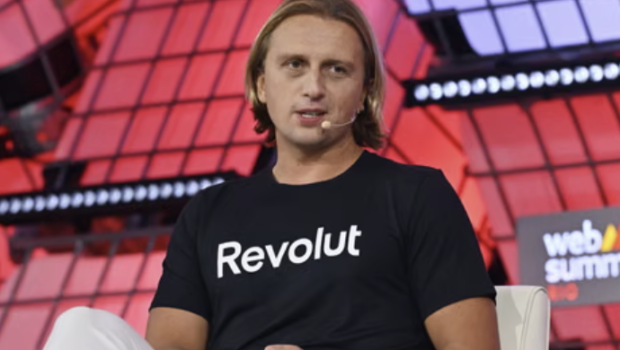
Nik Storonsky is the co-founder and CEO of Revolut, the London-based financial technology company he helped launch in 2015. He grew up in Russia and studied physics and applied mathematics before moving into finance. He spent several years as a derivatives trader at investment banks, including Credit Suisse, a role that demanded quantitative precision and deep familiarity with complex financial instruments. That time on the trading floor honed his understanding of risk and sharpened his instinct for identifying inefficiencies in markets, particularly in the mechanics of currency exchange and transaction costs.
Founding Revolut
In 2015, Storonsky co-founded Revolut alongside Vlad Yatsenko, another former banker. The initial concept was commercially straightforward but pointed at a genuine gap: a prepaid card that allowed customers to exchange currencies at interbank rates, avoiding the fees that traditional banks and card networks routinely charged travellers and internationally mobile professionals. The product spread quickly among users who had grown frustrated with opaque foreign exchange costs.
From that starting point, Storonsky pushed Revolut’s product range well beyond its origins. The platform added current-account-like services, stock trading, cryptocurrency access and business accounts, while the company pursued banking licences in multiple jurisdictions to strengthen its regulatory standing. At various points, Revolut’s valuation has exceeded tens of billions of dollars, placing it among the most valuable fintechs in Europe.
Product Expansion and Regulatory Strategy
Under Storonsky’s leadership, Revolut has pursued a strategy of continuous product expansion while keeping customer acquisition largely digital and costs structurally lower than those of incumbent retail banks. The competitive logic is direct: by integrating payments, trading and savings into a single app, Revolut competes for relationships that traditional institutions have long held by default.
The regulatory path has required sustained engagement across multiple national authorities, each with distinct compliance expectations. Storonsky has framed this process as a necessary step in Revolut’s maturation rather than a constraint on its ambitions, and the company has gradually added formal banking authorisations in key markets. His appearance on Bloomberg’s “The David Rubenstein Show” in September 2026 reflected a broader shift: a founder once focused primarily on engineering and growth metrics now engaging with a mainstream financial and investor audience.
The ChatGPT Yacht
The anecdote that has circulated most widely in recent coverage of Storonsky offers a vivid window into how he applies digital tools beyond corporate strategy. According to Bloomberg, he used ChatGPT to identify the previous owner of a superyacht priced at approximately €350 million. Armed with that information, his team approached the seller directly and negotiated a private purchase outside formal brokerage channels. His lawyers stated in related proceedings that this approach bypassed a commission that brokers estimated at around €17.5 million, a move that subsequently led to litigation with the brokerage involved.
The story is less remarkable for its scale than for what it reveals about the consistency of Storonsky’s instincts. He built Revolut by targeting the hidden fees embedded in currency exchange; here, he applied the same logic to a luxury asset transaction, querying an AI assistant to locate an intermediary, and then cutting that intermediary out. For a physicist turned trader turned fintech founder, the impulse to challenge established gatekeepers whenever a digital route appears more efficient seems to run deeper than corporate strategy alone.