From Consumer Goods to Global Pharma
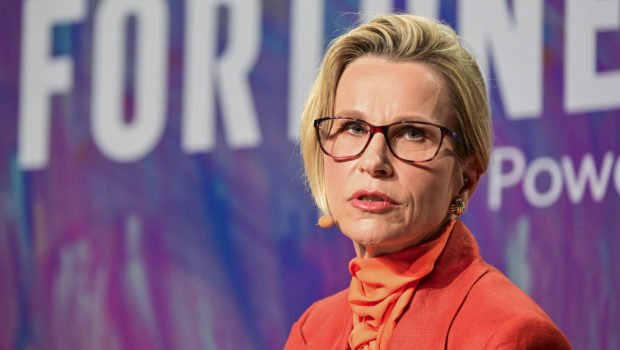
Emma Walmsley’s route to the top of two Fortune 500 companies began at the University of Oxford, where she read modern languages. After graduating, she joined L’Oréal, the French cosmetics group, and remained there for seventeen years, moving through roles in consumer marketing and regional management across Europe and Asia. She joined GlaxoSmithKline in 2010 to lead its consumer healthcare division, overseeing brands including Sensodyne toothpaste and Panadol. That operational grounding inside GSK preceded her appointment as chief executive officer in April 2017.
Her elevation was widely noted in British business circles. She became one of the few women to lead a major European pharmaceutical company, and Fortune described the moment as making her “Britain’s most powerful businesswoman.” Some in the industry questioned whether a career rooted in consumer goods, rather than pharmaceutical research, was adequate preparation for running a drug company. The appointment went ahead regardless, and what followed was a sustained restructuring programme.
Restructuring GSK and Turning a Critic into an Ally
At GSK, Walmsley concentrated the company’s portfolio on vaccines and specialty medicines, moving away from its broader consumer health exposure. That strategic refocus culminated in the separation of the consumer health arm into a standalone listed company, Haleon, in 2022, one of the largest demergers in British corporate history. The move freed GSK to allocate capital toward its pharmaceutical and vaccine pipeline.
The process was not without friction. Activist investor Elliott Management, which had accumulated a significant position in GSK, applied sustained pressure on the company’s strategic direction and, implicitly, on Walmsley’s continued tenure. Rather than retreating or escalating publicly, she engaged with Elliott methodically. Fortune later described the outcome in a piece headlined “How GSK CEO Emma Walmsley kept her job and turned a belligerent activist investor into an ally,” illustrating how she converted an adversarial dynamic into a working relationship while keeping her strategic agenda broadly intact.
She also demonstrated resilience when losses linked to Zantac cancer lawsuits weighed on the company’s third-quarter results. Even under that litigation pressure, she maintained public guidance for 2024 and continued to frame GSK’s pipeline as the primary basis for investor confidence.
A Performance Culture Built on Accountability
Colleagues quoted in a Financial Times profile called Walmsley a “strong and dynamic” leader who sets clear objectives surrounded by a dense network of key performance indicators. The same profile noted her willingness to invest in high-potential employees alongside a reputation for being direct about underperformance. She also served as a non-executive director at Microsoft, a credential that HP’s board would not have overlooked when searching for a chief executive capable of navigating an AI-disrupted hardware market.
One practice stands out in particular. At GSK, she implemented anonymous “180-degree” feedback surveys in which employees could assess their direct managers, including Walmsley herself. The results fed into leadership development processes across the organisation. For a chief executive to invite unfiltered assessment from subordinates as a matter of routine, rather than as a one-off listening exercise, reflects a particular view of accountability: that it should run upward as much as downward.
HP and a Third Act in Technology
In November 2026, HP Inc announced that Walmsley would become its chief executive officer on 4 January 2027, succeeding interim CEO Bruce Broussard, who will transition to board chair. HP, ranked 84th on the Fortune 500, operates in the PC and printing markets and faces structural pressure as AI-driven hardware begins to reconfigure demand across both segments.
For Walmsley, the move extends a career path that has crossed three distinct sectors over roughly two decades. She arrives at HP having led consumer goods divisions at L’Oréal and then pharmaceutical operations at GSK, with technology hardware as the next chapter. Her restructuring experience from the Haleon demerger and her track record navigating a sustained activist campaign are precisely the credentials HP’s board cited as relevant to its own strategic challenges.
The human detail that perhaps best defines her leadership sits in those anonymous feedback surveys. At a company where the CEO regularly received unfiltered assessments of her own performance from the people she led, the data did not always flatter. Walmsley not only kept the system running but built it into GSK’s leadership framework. That choice, more than any single transaction, says something specific about how she runs an organisation.